

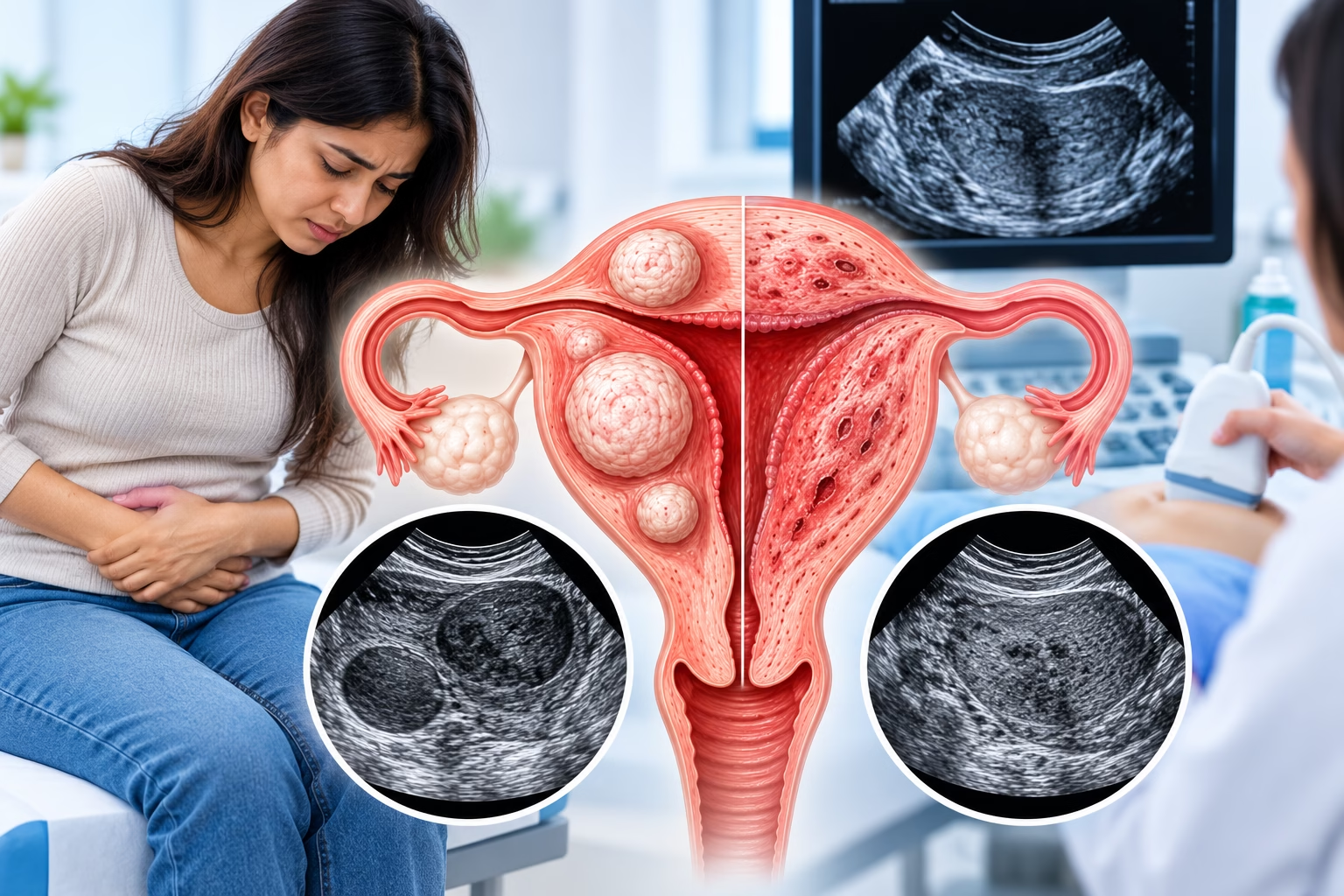
Uterine fibroids and adenomyosis are two of the most common causes of heavy periods, pelvic pain, and an enlarged uterus. Because they can cause overlapping symptoms, many women are unsure which condition they have, or whether they might have both at the same time. Understanding the difference can help you know what to expect from diagnosis and treatment.
If you have heavy periods, pelvic pain, or pressure, book your pelvic ultrasound at MVR Diagnostic Clinic to help identify the cause. Read this guide to understand how fibroids and adenomyosis differ in symptoms, ultrasound findings, diagnosis, and treatment.
What Are Uterine Fibroids?
Uterine fibroids, also called leiomyomas, are noncancerous growths that develop from the muscular wall of the uterus. They can vary widely in size, number, and location. Some women have fibroids without knowing it, while others experience significant symptoms.
Read more in our dedicated guide on uterine fibroids: causes, symptoms, and ultrasound findings.
What Is Adenomyosis?
Adenomyosis occurs when tissue similar to the endometrial lining grows into the muscular wall of the uterus, rather than staying confined to the inner lining where it normally belongs. This displaced tissue continues to respond to the menstrual cycle, which can cause the uterine wall to thicken and become tender.
Read more in our dedicated guide on adenomyosis: causes, symptoms, and ultrasound findings.
Fibroids vs Adenomyosis: Key Differences
While both conditions affect the uterus and can cause similar symptoms, they differ in their underlying nature, origin, and typical findings.
| Feature | Uterine Fibroids | Adenomyosis |
|---|---|---|
| What it is | Solid growths of muscle tissue | Endometrial-like tissue within the uterine muscle |
| Structure | Well-defined, distinct masses | Diffuse thickening, less well-defined |
| Common age group | Reproductive age, often in the 30s and 40s | Often women in their 40s, especially after childbirth |
| Number or distribution | Can be single or multiple | Typically affects the uterus diffusely |
| Pain pattern | Pressure, bulk symptoms, or pain if degenerating | Often painful periods that worsen over time |
| Uterine size | Can cause significant enlargement | Uterus is often mildly to moderately enlarged |
| Can coexist? | Yes | Yes |
What Are the Symptoms of Fibroids vs Adenomyosis?
Symptoms of Uterine Fibroids
- Heavy or prolonged menstrual bleeding
- Pelvic pressure or a feeling of fullness
- Pain if a fibroid is pressing on nearby structures
- Frequent urination from pressure on the bladder
- Lower back pain
- Enlarged lower abdomen in larger cases
- Difficulty conceiving in some cases
Symptoms of Adenomyosis
- Heavy menstrual bleeding
- Painful periods that often worsen over time
- Chronic pelvic pain, not limited to menstruation
- Pain during intercourse
- An enlarged, sometimes tender uterus
- Pain not relieved by typical pain medication in severe cases
Because both conditions share symptoms such as heavy bleeding and pelvic pain, symptoms alone cannot reliably distinguish between them. If you are experiencing changes in your cycle, our guide on abnormal menstruation and the types of irregular periods explains when these changes need evaluation.
Can You Have Both Fibroids and Adenomyosis?
Yes. It is common for both conditions to occur together in the same uterus. When this happens, symptoms can be more pronounced, and distinguishing the contribution of each condition can be more challenging on examination alone. This is why imaging plays an important role.
How Are Fibroids and Adenomyosis Diagnosed?
Diagnosis usually begins with a review of your symptoms and medical history, followed by a pelvic examination. Imaging is then used to confirm the diagnosis and distinguish between the two conditions.
Common diagnostic steps include:
- Pelvic examination
- Pelvic ultrasound
- Transvaginal ultrasound for more detailed imaging
- MRI in selected or complex cases
- Blood tests to assess general health, such as an anemia profile and iron studies if heavy bleeding is present
Fibroids vs Adenomyosis on Ultrasound
Ultrasound, particularly transvaginal ultrasound, is the primary imaging test used to assess both conditions. Their appearance on ultrasound is one of the main ways doctors distinguish between them.
Fibroids on Ultrasound
- Well-defined, rounded masses within the uterine wall
- Often cause shadowing behind the mass
- Can be single or multiple
- May distort the shape or outline of the uterus
- Blood flow is typically seen around the edge of the mass
Adenomyosis on Ultrasound
- Diffuse thickening of the uterine wall, often more pronounced on one side
- Loss of clear definition between the endometrium and myometrium
- Small cyst-like areas within the uterine muscle
- A generally enlarged, globular-shaped uterus
- Less distinct borders compared with a fibroid
Because adenomyosis can sometimes be harder to distinguish clearly on ultrasound, especially in mild cases or when fibroids are also present, MRI may occasionally be recommended for a more detailed assessment when ultrasound findings are unclear.
When Is MRI Used Instead of Ultrasound?
MRI may be recommended when:
- Ultrasound findings are inconclusive
- Fibroids and adenomyosis may be present together and need to be distinguished
- Detailed mapping is needed before a procedure or surgery
- Symptoms persist despite unclear or normal ultrasound findings
MRI provides more detailed soft-tissue contrast, which can help clarify the extent and distribution of adenomyosis and the exact number, size, and location of fibroids.
Explore our MRI scan services in Dubai for more information.
What Is the Treatment for Fibroids vs Adenomyosis?
Treatment approaches overlap in some areas but differ because of the different nature of each condition.
Treatment for Fibroids
- Observation for small, symptom-free fibroids
- Medication to manage heavy bleeding or pain
- Minimally invasive procedures to shrink or remove fibroids
- Surgical removal of fibroids, known as myomectomy
- Hysterectomy in selected cases
Treatment for Adenomyosis
- Pain and bleeding management with medication
- Hormonal treatment to reduce symptoms
- Minimally invasive procedures in selected cases
- Hysterectomy, which remains the only definitive cure, for women who have completed childbearing and have severe symptoms
Because adenomyosis is confined to the uterine muscle itself, treatment options that preserve the uterus tend to be more limited compared with fibroids, which can often be individually removed. Treatment decisions depend on symptoms, medical history, and reproductive plans and should be discussed with a qualified doctor.
Can Fibroids or Adenomyosis Affect Fertility?
Both conditions can potentially affect fertility, depending on their size, location, and severity. Fibroids that distort the uterine cavity are more likely to interfere with implantation, while adenomyosis has been associated with reduced fertility and higher rates of certain pregnancy complications in some studies.
If you are trying to conceive and have either condition, discussing your specific situation with your doctor is important for personalized guidance.
When Should You See a Doctor?
See a doctor if you experience:
- Heavy or prolonged menstrual bleeding
- Pelvic pain that is worsening or persistent
- Pain during intercourse
- A noticeably enlarged abdomen
- Difficulty conceiving
- Any new or unusual pelvic symptoms
Early evaluation can help identify whether fibroids, adenomyosis, or another condition is responsible and guide you toward the most appropriate treatment.
Get Your Pelvic Ultrasound at MVR Diagnostic Clinic in Dubai
At MVR Diagnostic Clinic in Al Garhoud, Dubai, pelvic and transvaginal ultrasounds are performed by experienced professionals. Reports are reviewed by DHA-licensed consultant radiologists and delivered digitally within 24 hours.
You can also explore our full range of ultrasound services or MRI scan services if further imaging is needed.
Pelvic Ultrasound All Ultrasound Services MRI Scan Services Book on WhatsAppFrequently Asked Questions
What is the main difference between fibroids and adenomyosis?
Fibroids are distinct, well-defined growths of muscle tissue, while adenomyosis is a diffuse condition where endometrial-like tissue grows within the uterine muscle. This difference affects both their appearance on ultrasound and their treatment options.
Can fibroids and adenomyosis occur together?
Yes. Both conditions can be present in the same uterus at the same time, which can make symptoms more pronounced.
Which is more painful, fibroids or adenomyosis?
Both can cause pain, but adenomyosis is more classically associated with painful periods that worsen over time and chronic pelvic pain. Fibroids more often cause pressure and bulk-related symptoms, with pain in certain situations.
Can ultrasound tell the difference between fibroids and adenomyosis?
Yes. In many cases, ultrasound can distinguish between the two based on their different appearances. However, MRI may sometimes be needed for a clearer picture, especially when both conditions may be present together.
Do fibroids or adenomyosis require surgery?
Not always. Many cases are managed with medication or minimally invasive procedures. Surgery, including hysterectomy, is generally reserved for more severe or persistent cases, or when other treatments have not been effective.
Can fibroids or adenomyosis affect fertility?
Both conditions can potentially affect fertility depending on their size, location, and severity. A doctor can assess your specific situation and advise on the best approach if you are trying to conceive.