

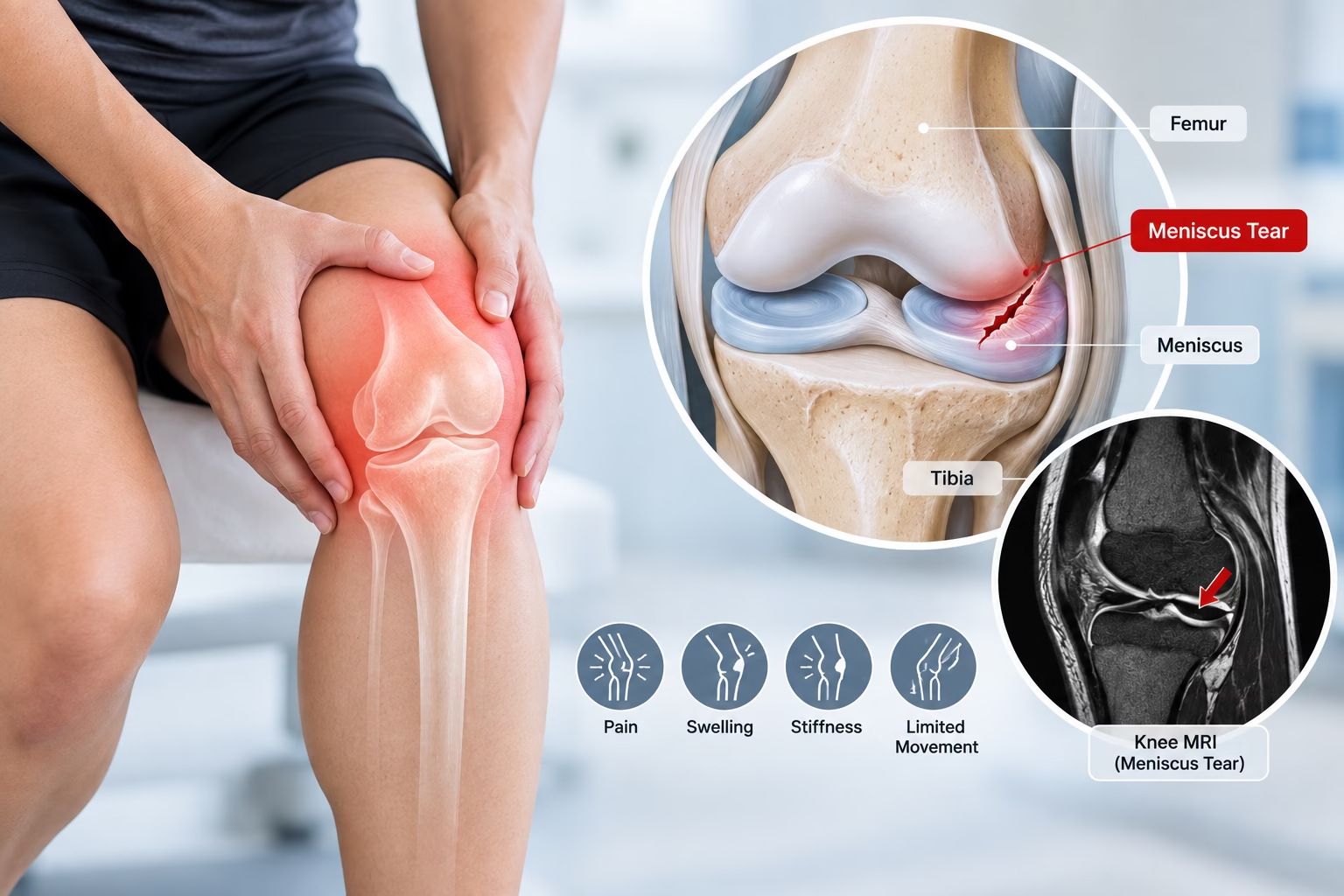
A meniscus tear is a common knee injury involving one of the two crescent-shaped pieces of cartilage that cushion the knee joint. It can happen after a sudden twisting or pivoting movement, a sports injury, or gradual age-related changes in the meniscus. Common symptoms include knee pain, swelling, stiffness, clicking, catching, and difficulty fully moving the knee.
If you have recently injured your knee and are experiencing pain, swelling, locking, or difficulty moving the joint, Book Your Knee MRI to help assess possible meniscus, ligament, cartilage, or other soft-tissue injuries. Read this guide to know more about meniscus tear causes, symptoms, MRI findings, diagnosis, treatment, and recovery.
The menisci are two wedge-shaped pieces of cartilage located between the thighbone and shinbone. Each knee has a medial meniscus on the inner side and a lateral meniscus on the outer side. They help distribute weight across the knee, absorb shock, improve stability, and support smooth movement.
A meniscus tear occurs when this cartilage is damaged. Tears can vary in size, location, and pattern. Some occur suddenly following an injury, while others develop gradually because the meniscus becomes less flexible with age.
A meniscus tear can result from a sudden injury or gradual degeneration.
A forceful twisting movement while the foot is planted can place significant stress on the meniscus. This commonly happens during sports involving sudden changes in direction, such as football, basketball, tennis, and similar activities.
Meniscus tears may occur during contact or non-contact sports, particularly when the knee is twisted while bearing weight. A meniscus tear can also occur alongside other knee injuries, including an ACL tear.
Repeated deep squatting, kneeling, or sudden movements from a squatting position can place stress on the meniscus.
With age, the meniscus can become less flexible and more vulnerable to tearing. A degenerative tear may occur during an everyday movement without a major traumatic injury.
A strong impact to the knee can also damage the meniscus, especially when the injury involves twisting or rotation.
Meniscus tears can be classified according to their shape, location, and direction.
Common patterns include:
The location of the tear is also important because different areas of the meniscus have different blood supplies. This can influence the potential for healing and the treatment approach.
Symptoms can vary depending on the size and location of the tear.
Common symptoms include:
Some people can continue walking after a meniscus injury, particularly when the tear is small or symptoms are mild.
Yes. A meniscus tear can cause swelling around or inside the knee. However, swelling can also occur with ACL injuries, cartilage damage, arthritis, and other knee conditions. The timing of swelling can provide useful information, but it cannot by itself confirm a meniscus tear.
Yes. Certain meniscus tears can cause catching or locking. A displaced tear, such as a bucket-handle tear, can interfere with normal knee movement and may prevent the knee from fully straightening. If your knee repeatedly locks or cannot fully straighten, medical evaluation is recommended.
Yes. Being able to walk does not rule out a meniscus tear. Some people experience pain mainly during activities such as:
If knee symptoms continue after an injury, further evaluation may be necessary.
A meniscus tear and an ACL tear involve different structures, but both can occur following a twisting knee injury.
| Feature | Meniscus Tear | ACL Tear |
|---|---|---|
| Structure affected | Meniscus cartilage | Anterior cruciate ligament |
| Common mechanism | Twisting or rotation | Pivoting, sudden stopping, awkward landing |
| Common symptoms | Pain, swelling, catching or locking | Pain, swelling and instability |
| Mechanical symptoms | Catching or locking can occur | Less characteristic unless other injuries are present |
| MRI | Evaluates the meniscus and associated structures | Evaluates the ACL and associated structures |
A single injury can damage both the meniscus and ACL, which is one reason MRI may be useful when significant internal knee injury is suspected.
If you want to understand ACL injuries in more detail, read our guide to know more about ACL tear causes, symptoms, MRI findings, diagnosis, and treatment .
Diagnosis usually begins with a medical history and physical examination.
Your doctor may ask:
During examination, the doctor may check for tenderness along the joint line and perform specific movements or tests. Joint-line tenderness, the McMurray test, and the Thessaly test may be used together when assessing suspected meniscal injury.
An X-ray does not directly show the meniscus because it is soft tissue.
However, X-rays can be useful for assessing the bones and identifying fractures, arthritis, or other bony abnormalities that may contribute to knee symptoms. When a meniscus injury is suspected, MRI provides more detailed imaging of the meniscus and other soft tissues inside the knee.
MRI is commonly used to evaluate suspected meniscus tears because it provides detailed images of soft tissues inside the knee.
A knee MRI can assess:
MRI can also help identify associated injuries that may have occurred during the same event.
The MRI appearance depends on the type and severity of the tear.
A tear may appear as abnormal signal extending to an articular surface of the meniscus.
The normal contour of the meniscus may become altered depending on the tear pattern.
Some tears can cause part of the meniscus to move from its normal position. This may be associated with catching or locking.
MRI can help identify the direction and pattern of the tear.
MRI can also identify associated findings involving:
MRI findings should be interpreted together with symptoms and physical examination. Meniscal abnormalities can also occur in people without symptoms, particularly with increasing age, so an MRI finding does not automatically mean that it is the cause of the patient's pain.
Your doctor may consider MRI when:
MRI is not necessary for every episode of knee pain. The decision depends on the clinical examination, symptoms, injury mechanism, and whether the imaging result is likely to affect management.
If your knee pain continues without a clear diagnosis, read our guide to know more about persistent joint pain and when an MRI may help .
During a knee MRI, you generally lie on your back while the affected knee is positioned within a dedicated imaging coil. The table then moves into the MRI scanner. The examination is non-invasive and does not use ionizing radiation. You will hear repetitive tapping or knocking sounds while images are acquired. Remaining still is important because movement can reduce image quality.
If you want to know more about the examination time, read our guide on how long a knee MRI takes to understand the typical scan duration and what to expect.
A routine MRI for a suspected meniscus tear is generally performed without contrast. Contrast may be considered for specific clinical questions or certain postoperative and complex conditions, but it is not routinely required for a straightforward suspected meniscus tear.
The decision should be made by the referring doctor and radiologist based on the reason for the examination.
Treatment depends on several factors, including:
Not every meniscus tear requires surgery.
Temporarily reducing activities that aggravate the knee can help control symptoms. Depending on the injury, this may involve avoiding running, jumping, deep squatting, or twisting movements.
Your doctor may recommend medication to manage pain and inflammation when appropriate.
Physiotherapy can help improve:
Physical therapy may be used as part of non-surgical treatment or rehabilitation following surgery.
In selected cases, a doctor may consider an injection to help manage pain or inflammation. The appropriate option depends on the individual's condition.
Surgery may be considered when symptoms continue despite non-surgical treatment or when a tear causes significant mechanical problems. When surgery is required, preserving as much healthy meniscal tissue as possible is generally an important consideration because the meniscus contributes to the function and protection of the knee joint.
During a repair, the surgeon attempts to preserve and repair the torn meniscus when the tear's location and characteristics make healing possible.
If the damaged portion cannot be repaired, the surgeon may remove the unstable portion while preserving as much healthy meniscus as possible. The appropriate surgical approach depends on the individual tear and the patient's symptoms and circumstances.
Some meniscus tears can improve with non-surgical treatment, but healing potential depends partly on the location of the tear and its blood supply. The outer portion of the meniscus has a better blood supply than the inner portion. Tears in areas with limited blood supply may have less potential for natural healing. This is one reason why the location and pattern of the tear are important when discussing treatment options.
Recovery varies significantly between individuals. A smaller tear treated without surgery may improve over several weeks, while a surgically repaired tear can require a longer rehabilitation period.
Recovery can depend on:
Your healthcare professional can provide a more individualized recovery timeline after evaluating the injury.
Arrange a medical assessment if you experience:
Urgent evaluation may be necessary after severe trauma, major swelling, obvious deformity, inability to bear weight, or a knee that becomes completely locked.
A meniscus tear can cause knee pain, swelling, stiffness, locking, or difficulty moving the joint. If these symptoms persist after an injury or do not improve with initial treatment, your doctor may recommend an MRI to assess the meniscus and other structures inside the knee. MRI can help identify the location and extent of a tear and provide information that may guide further treatment.
If you have ongoing knee pain, swelling, locking, or instability after an injury, Book Your Knee MRI at MVR Diagnostic Clinic for detailed imaging of the knee joint and its soft tissues.
Yes. MRI provides detailed images of the knee's soft tissues and can identify meniscal tears and associated injuries.
No. Treatment depends on the tear, symptoms, mechanical problems, associated injuries, and individual circumstances. Many cases can initially be managed without surgery.
Yes. Some people can walk with a meniscus tear. Walking normally does not rule out a meniscal injury.
No. Swelling can occur, but not every meniscus tear causes obvious swelling.
MRI may show abnormal signal extending to the surface of the meniscus, changes in its shape, a specific tear pattern, or a displaced fragment. The appearance depends on the type and location of the injury.
Some tears may improve with non-surgical treatment. Healing potential depends partly on the location and blood supply of the tear.
X-rays are useful for evaluating bones but do not directly show the meniscus. MRI provides detailed images of soft tissues and can evaluate the menisci and other internal knee structures.
The scan time varies depending on the protocol and imaging requirements. Your imaging center can provide the expected examination duration when you schedule the scan.
WhatsApp us