

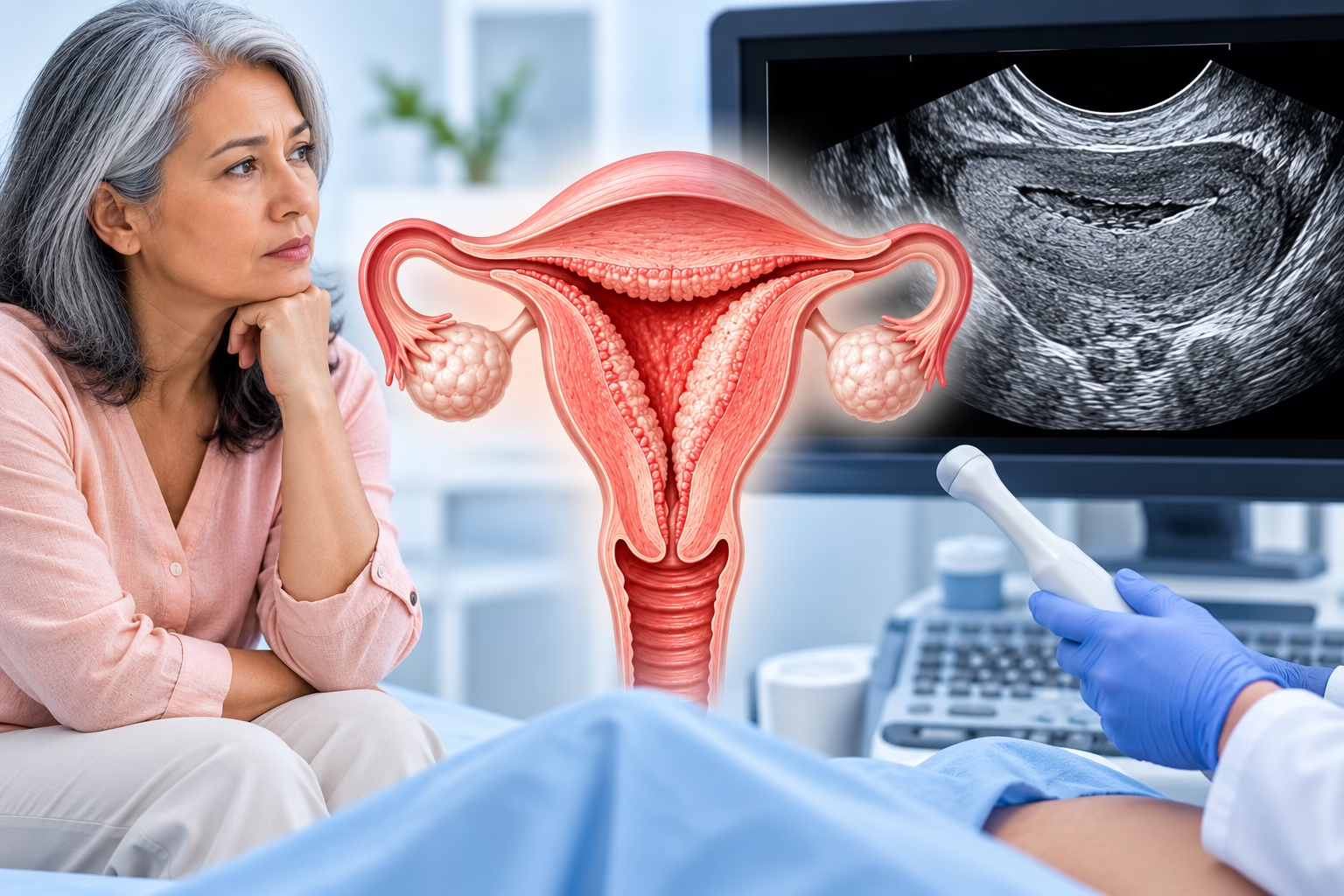
The endometrium is the lining inside the uterus, and its thickness naturally changes throughout a woman's reproductive years. After menopause, the endometrium is normally thin because of reduced hormone levels. A thickened endometrium found after menopause is not always a cause for alarm, but it does need proper evaluation, since it can sometimes point to an underlying condition that requires attention.
If you have been told your endometrium looks thickened on a scan, or you are experiencing postmenopausal bleeding, book your pelvic ultrasound at MVR Diagnostic Clinic to help identify the cause.
Read this guide to understand what a thick endometrium after menopause means, its possible causes, ultrasound findings, diagnosis, and next steps.
Have you been told that your endometrium is thickened after menopause?
A pelvic or transvaginal ultrasound can help evaluate the endometrial lining and identify findings that may need further assessment. Book your pelvic ultrasound at MVR Diagnostic Clinic.
After menopause, estrogen and progesterone levels drop significantly, and the endometrial lining normally becomes thin and inactive. A thickened endometrium refers to a lining that measures more than the expected range for a postmenopausal woman on ultrasound.
There is no single universal cutoff that applies to every woman. The significance of a thickened measurement depends on factors such as whether you are experiencing bleeding, whether you are on hormone therapy, and your overall ultrasound findings.
Your doctor will interpret the measurement together with your symptoms and history.
Several conditions can cause the endometrial lining to appear thickened after menopause.
Polyps are growths of the endometrial lining that can cause the endometrium to appear focally or generally thickened on ultrasound.
You can read more in our guide on endometrial polyps: causes, symptoms, and ultrasound findings .
This refers to an overgrowth of the endometrial cells, often related to estrogen exposure without enough progesterone to balance it. Some forms of hyperplasia carry a higher risk of progressing to cancer over time.
Certain types of hormone therapy, particularly estrogen-only therapy without adequate progesterone, can cause the endometrium to thicken.
Tamoxifen, a medication used in breast cancer treatment, is associated with endometrial thickening and an increased likelihood of polyps.
Fat tissue can convert other hormones into estrogen, and higher estrogen levels can contribute to endometrial thickening.
In a smaller proportion of cases, a thickened endometrium after menopause can be due to endometrial cancer. This is one of the main reasons why postmenopausal endometrial thickening, particularly with bleeding, is taken seriously and investigated promptly.
Certain factors may increase the likelihood of a thickened endometrium after menopause:
However, endometrial thickening can also occur in women without these risk factors.
Not always. Some women have no symptoms at all, and a thickened endometrium is discovered incidentally during a pelvic ultrasound performed for another reason.
In other cases, the most common symptom is postmenopausal bleeding, which refers to any vaginal bleeding or spotting occurring after menopause has been confirmed.
Postmenopausal bleeding should never be assumed to be harmless. Even light spotting needs to be evaluated, since it is one of the key warning signs associated with endometrial conditions, including cancer.
Medical evaluation is particularly important if you have:
Your doctor will weigh these factors together rather than relying on the endometrial thickness measurement alone.
Diagnosis usually starts with a review of your symptoms, menstrual and hormonal history, and any medications you are taking, followed by a pelvic examination.
Common diagnostic steps include:
Pelvic ultrasound, particularly transvaginal ultrasound, is the first-line imaging test for evaluating a thickened endometrium. It is painless, does not use radiation, and gives a clear measurement of endometrial thickness along with information about its appearance.
Ultrasound can help assess:
On ultrasound, a thickened endometrium appears as an increased measurement of the endometrial stripe compared with the expected postmenopausal range. The appearance can vary depending on the underlying cause.
Ultrasound findings alone cannot definitively diagnose the cause of thickening, so additional tests are often recommended depending on the appearance and your symptoms.
| Feature | Normal Postmenopausal Endometrium | Thickened Endometrium |
|---|---|---|
| Typical appearance | Thin, uniform line | Thickened, uniform or focal |
| Bleeding | Usually absent | May or may not be present |
| Further testing | Often not needed if no symptoms | Often recommended, especially with bleeding |
| Common causes | N/A | Polyps, hyperplasia, hormone therapy, rarely cancer |
Any postmenopausal bleeding, regardless of how the endometrium measures on ultrasound, should be evaluated by a doctor.
Depending on your symptoms and ultrasound findings, further evaluation may include:
Treatment depends entirely on the underlying cause.
In selected cases with no bleeding and low-risk ultrasound features, your doctor may recommend observation and follow-up ultrasound.
If a polyp is identified, hysteroscopic removal is often recommended, particularly in postmenopausal women.
If hyperplasia without concerning features is found, hormonal treatment may be used to help thin the lining, depending on the type of hyperplasia.
These procedures allow direct examination of the uterine cavity and tissue sampling to confirm the diagnosis and guide further treatment.
If hyperplasia with concerning features or endometrial cancer is diagnosed, you will be referred to a specialist for further management, which may include additional procedures or surgery depending on the findings.
In some cases, yes. If the thickening is related to a reversible cause, such as certain hormone therapy or a polyp that is removed, the endometrium can return to a more typical postmenopausal appearance.
Hyperplasia may also improve with appropriate hormonal treatment and monitoring. Follow-up ultrasound is often used to track these changes over time.
See a doctor if you experience:
Early evaluation allows your doctor to identify the cause and recommend appropriate management, which is particularly important for ruling out more serious conditions.
At MVR Diagnostic Clinic in Al Garhoud, Dubai, pelvic and transvaginal ultrasounds are performed by experienced professionals, with reports reviewed by DHA-licensed consultant radiologists and delivered digitally within 24 hours.
You can also explore our women's health blood tests if hormonal evaluation is needed.
Book your pelvic ultrasound at MVR Diagnostic Clinic today and get clear answers about your results.
There is no single universal cutoff, as the significance depends on your symptoms, whether you are on hormone therapy, and other ultrasound findings. Your doctor interprets the measurement in context rather than relying on a single number.
No. Many cases are due to benign causes such as polyps or hormone therapy. However, because it can occasionally indicate a more serious condition, evaluation is recommended, especially if bleeding is present.
Common causes include endometrial polyps, endometrial hyperplasia, hormone replacement therapy, tamoxifen use, and obesity. In a smaller number of cases, it can be due to endometrial cancer.
Not necessarily. Most cases are due to benign causes. However, because endometrial cancer is one possible cause, further testing such as a biopsy is often recommended to rule it out, particularly with bleeding.
Yes. Treatment depends on the cause and may include monitoring, polyp removal, hormonal treatment, or referral to a specialist for further management.
Even without symptoms, an incidental finding of a thickened endometrium should be discussed with your doctor, who can advise whether further testing or monitoring is appropriate based on your individual risk factors.
WhatsApp us