

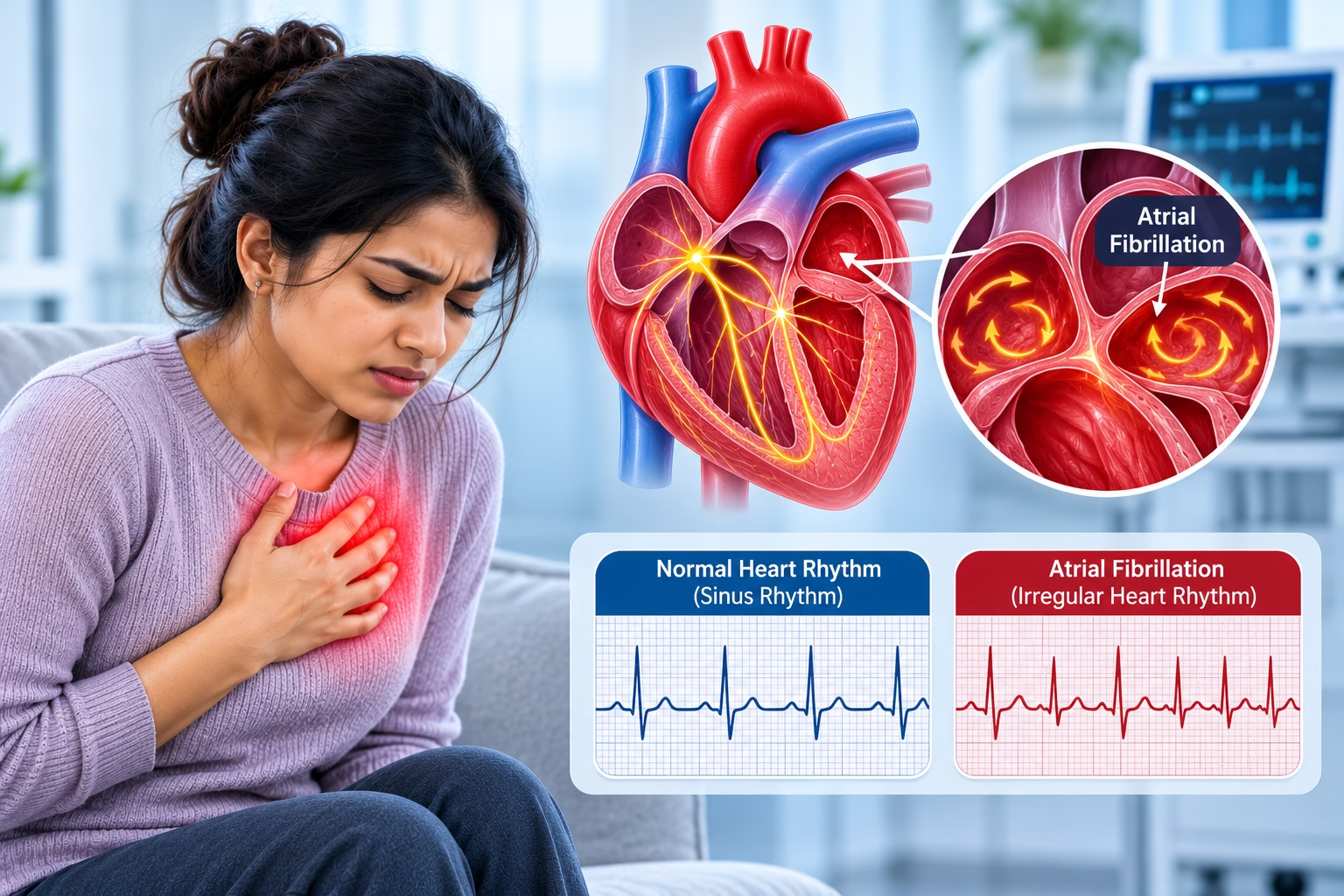
Atrial fibrillation, often called AFib, is the most common type of irregular heart rhythm. Instead of beating in a steady, coordinated pattern, the upper chambers of the heart quiver chaotically. This can cause a fast, irregular pulse and, over time, increase the risk of stroke and heart failure.
Some people experience noticeable symptoms, while others have no symptoms and discover the condition during a routine health check.
If you have palpitations, dizziness, or an irregular heartbeat, an ECG test at MVR Diagnostic Clinic can help your doctor investigate the cause.
The heart has four chambers. The two upper chambers, known as the atria, normally contract in a regular rhythm. Electrical signals from the heart's natural pacemaker coordinate these contractions and help move blood into the two lower chambers, called the ventricles.
In atrial fibrillation, the electrical signals in the atria become disorganised and extremely rapid. Instead of contracting properly, the atria quiver. The ventricles respond with an irregular and often fast heartbeat.
Atrial fibrillation is classified into four main types:
Episodes that start and stop on their own, usually within a week.
Episodes lasting longer than a week, which often require treatment to stop.
Continuous atrial fibrillation lasting more than one year.
Atrial fibrillation accepted as an ongoing condition, with treatment focused on controlling heart rate and preventing stroke.
AFib develops when something disrupts the heart's normal electrical system. Several health conditions and lifestyle factors can contribute to its development.
Long-standing high blood pressure puts additional strain on the heart and is one of the most common contributors to atrial fibrillation.
Coronary artery disease, heart valve problems, heart failure, cardiomyopathy, previous heart attacks, and heart surgery can increase the risk of AFib.
An overactive thyroid can speed up the heartbeat and trigger atrial fibrillation. A thyroid function test may therefore be included in the medical evaluation.
Both diabetes and obesity are associated with a higher risk of developing AFib. Managing these conditions can form an important part of overall heart health.
Heavy drinking, binge drinking, and certain stimulants can trigger AFib episodes in some people.
Untreated obstructive sleep apnea is strongly linked to atrial fibrillation and can contribute to recurring episodes.
Acute illness, lung conditions, and the physical stress associated with surgery can sometimes trigger an episode.
AFib becomes more common with age. Some people may also inherit a tendency to develop the condition.
Certain health conditions and personal factors can increase the likelihood of developing atrial fibrillation.
Important: Atrial fibrillation can also occur in people who have no obvious risk factors.
AFib symptoms vary from person to person. They may appear suddenly, come and go, or remain unnoticed for a long time.
Some people have no symptoms at all. In these cases, AFib may be discovered during a routine ECG or physical examination. Even without noticeable symptoms, the condition can increase stroke risk and needs proper medical assessment.
Do not wait for a routine ECG appointment if these symptoms occur. Seek emergency care immediately.
AFib can allow blood to pool in the atria, where blood clots may form. If a clot travels to the brain, it can cause a stroke. This is why symptoms of a possible stroke always require urgent medical attention.
Diagnosis usually begins with a review of symptoms and medical history, followed by a physical examination. The doctor checks the pulse and listens to the heart for an irregular rhythm.
Because AFib can come and go, confirming the condition often depends on recording the abnormal rhythm when it occurs.
| Test | Purpose |
|---|---|
| ECG (Electrocardiogram) | Records the heart's electrical activity and identifies an irregular rhythm. |
| Holter Monitor | Records heart activity over 24 to 48 hours or longer to detect intermittent episodes. |
| Event or Wearable Monitor | Helps detect episodes that occur less frequently. |
| Blood Tests | Checks for possible contributing conditions, including thyroid problems, kidney disorders, and electrolyte imbalances. |
| Echocardiogram | Assesses the heart's structure, chambers, valves, and pumping function. |
| Chest X-ray | May be used in selected cases to assess the chest and lungs. |
| Sleep Study | May be recommended if obstructive sleep apnea is suspected. |
An electrocardiogram, commonly called an ECG or EKG, is the key test used to diagnose atrial fibrillation. It is quick, painless, and records the heart's electrical activity through small sensors placed on the chest, arms, and legs.
A standard ECG takes only a few minutes and shows the heart rhythm at the time of testing. If AFib is intermittent and does not occur during the recording, a doctor may recommend longer heart monitoring.
Learn more about ECG testing and the available diagnostic services at MVR Diagnostic Clinic.
A normal ECG generally shows regular, evenly spaced heartbeats. Each normal beat is preceded by a clear P wave, which represents electrical activity associated with atrial contraction.
In atrial fibrillation, the ECG typically shows the following changes:
The gaps between heartbeats vary unpredictably rather than following a regular pattern.
The normal, organised atrial electrical signal is replaced by chaotic electrical activity.
The ECG may show a wavy, uneven baseline instead of clear P waves.
The heart rate may be fast, often above 100 beats per minute when untreated, but it can also be normal or slow.
A doctor interprets the ECG alongside the person's symptoms and medical history because other heart rhythm problems can sometimes produce similar findings.
Depending on the symptoms and initial findings, a doctor may recommend additional tests to understand the frequency of AFib episodes and assess overall heart health.
Treatment for atrial fibrillation has three main goals: controlling the heart rate, restoring a normal rhythm where appropriate, and reducing the risk of stroke. The recommended approach depends on the type of AFib, symptoms, age, and other medical conditions.
Many people with AFib are prescribed blood-thinning medicines, also called anticoagulants, to reduce the risk of blood clots. A doctor assesses individual stroke risk before deciding whether these medicines are necessary. Never start or stop anticoagulant medication without medical advice.
Rate-control medicines slow the heart rate when it beats too quickly. This can help ease symptoms and protect the heart's function.
Some people may need treatment to restore and maintain a normal heart rhythm. Options include:
Managing high blood pressure, thyroid disease, sleep apnea, diabetes, and other contributing conditions is an important part of AFib treatment.
Reducing alcohol intake, maintaining a healthy weight, staying physically active as advised by a doctor, and managing stress may help reduce episodes. Managing cholesterol is also important for overall cardiovascular health. Read more about the risks of high cholesterol.
Paroxysmal AFib, by definition, starts and stops on its own. However, episodes may return and can become more persistent over time.
Even when symptoms disappear, medical follow-up remains important. The risk of stroke and the underlying causes may still be present. Do not assume that AFib has resolved without medical confirmation.
Not every case of AFib can be prevented. However, managing health conditions and making certain lifestyle changes may help lower the risk.
Arrange a medical assessment if you experience any of the following symptoms:
Early evaluation helps confirm the cause of these symptoms and supports timely management of possible complications, particularly stroke. If you experience severe chest pain, sudden breathlessness, fainting, or stroke symptoms, seek emergency care rather than waiting for a routine appointment.
At MVR Diagnostic Clinic in Al Garhoud, Dubai, ECG testing is quick, painless, and performed by trained professionals. The results are made available for your doctor to review and interpret alongside your symptoms and medical history.
If further investigations are required, you can also explore our blood test services.
Experiencing palpitations, dizziness, or an irregular heartbeat? Book an ECG test at MVR Diagnostic Clinic and take the next step towards understanding your heart health.
Book Your ECG Test WhatsApp UsPalpitations, described as a fluttering, racing, or irregular heartbeat, are the most common symptom. Shortness of breath, fatigue, and dizziness are also common. However, some people have no symptoms at all.
Yes. An ECG is the main test used to diagnose AFib. It typically shows an irregularly irregular rhythm with absent P waves. If episodes come and go, longer monitoring with a Holter or event recorder may be needed.
It can be. AFib increases the risk of stroke and may contribute to heart failure if left untreated. With appropriate treatment and medical follow-up, many people manage the condition well.
Some people experience long periods without AFib after treatments such as catheter ablation or after underlying causes are addressed. However, the condition can return, and many people manage it over the long term with medication and lifestyle changes.
Common triggers include alcohol, caffeine, stress, illness, lack of sleep, and untreated conditions such as high blood pressure, thyroid disease, and sleep apnea.
Many people with AFib need anticoagulant medication, but this depends on individual stroke risk. A doctor will assess your medical history and advise whether blood-thinning medication is appropriate.
Yes. Some people do not experience noticeable symptoms and are diagnosed during a routine ECG or health checkup. This is one reason why medical assessment is important when AFib is suspected.
WhatsApp us